The Project at 13° Berlin Biennale
The project develops within Berlin’s participatory network as if it were a city without borders, founded on a historical search for freedom and social justice, and for this reason everyone can participate in the proposed actions wherever they are and propose others themselves.
This shared action is part of the project Die Komödie! by Anna Scalfi Eghenter, artist participating in the 13th Berlin Biennale for Contemporary Art, curated by Zasha Colah and Valentina Viviani
The project is specific to the site at Lehrter Strasse 60, in the former military court where Karl Liebknecht was imprisoned and sentenced in 1916 for distributing a protest leaflet on 1 May calling for the international union of workers and soldiers. The title “Die Komödie!” refers to what Karl Liebknecht said when the judges expelled the public from the trial: “Go out and laugh at this comedy,” and introduces the different spaces of the work in which Scalfi Eghenter highlights the extreme actuality of his words.
In the former military court itself, she starts from the original text of the 1916 leaflet, creating a red storm in which one can immerse oneself in the space of the gatehouse. She starts from the text of Liebknecht’s trial, which resonates electronically from the floor, together with photographic materials used in GDR ministry didactics, which emerge in videos embedded in the floor, together with fisheye lenses of the archive spaces below, closed to public access.
The connecting corridors on the ground floor host small, colourful armies of toy consumers, leading to a room of military maps showing countries that do not exist, created by the market extensions of nuclear bombs, pesticides, browsers, credit cards and big pharma.
These are countries created by the votes of savers, who entrust their money to financial funds that guarantee social security and health services.
A row of monitors displays a colourful map in progress, showing the action activated in the city by this platform. The project aims to unite participation in independent circuits, to come together in person or simultaneously, trusting in the possible localisation of an immaterial common good, made up of interests, needs and protests, which can become a resource that cannot be sold.
Consumers of the world, unite!
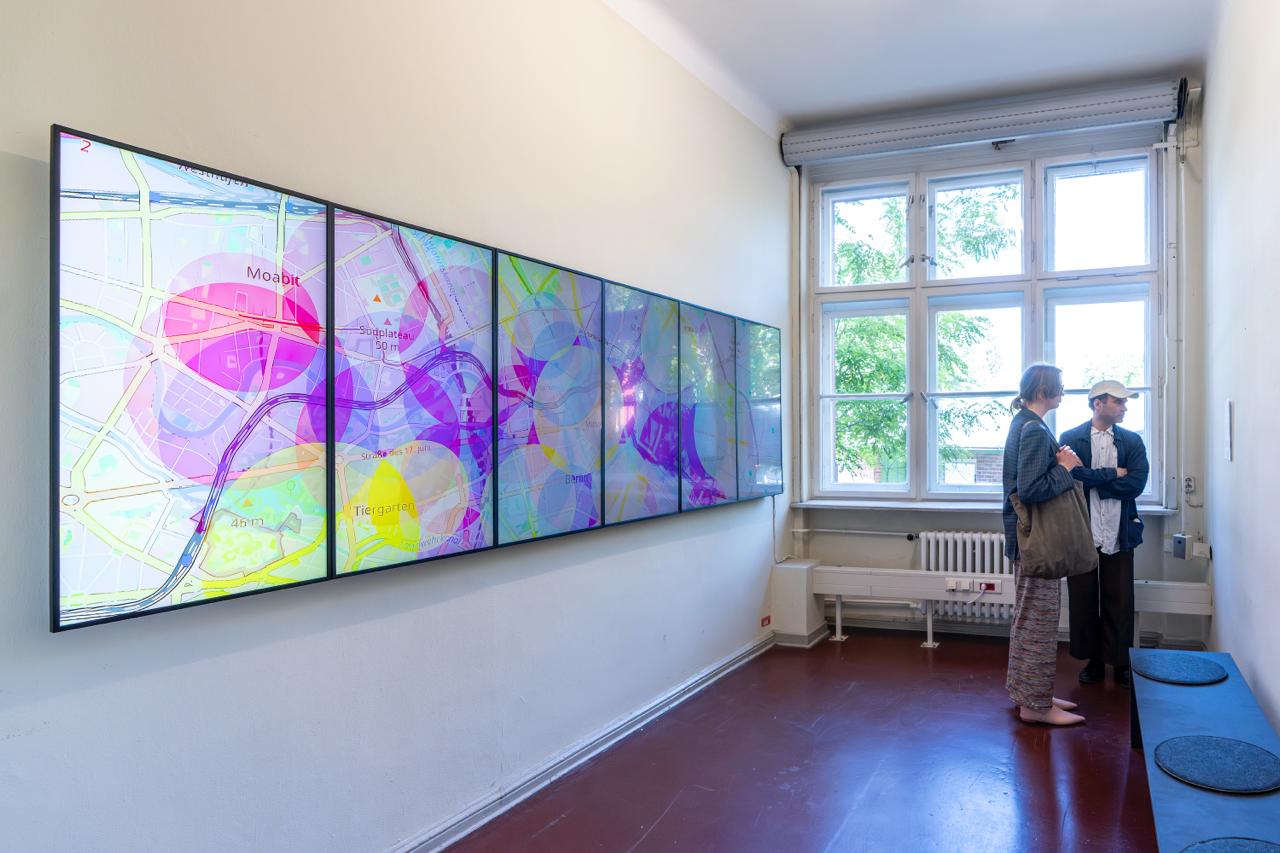
2025, Anna Scalfi Eghenter, Die Komödie! [The Comedy!], 14/06-14/09, in 13th Berlin Biennale, curated by Zasha Colah and Valentina Viviani, supported by Italian Council – 14th ed., Direzione Generale Creatività Contemporanea, Ministero della Cultura, Former Courthouse Lehrter Straße 60, Berlin / ph. Ela Bialkowska, OKNOstudio